Session Taint and Information Flow
On this page
Some controls cannot be decided from a single request. “Do not send anything externally after reading secret data” depends on what the session did earlier. PPE tracks that history as Session Taint: labels attached to a session that later policy can read. This is how PPE enforces information-flow control, including write-down prevention.
Information-flow requirement
A caller reads compensation data, then asks the agent to send an email. The email body is clean: no SSN, no salary, nothing sensitive in the text. It should still be blocked, because this session has handled secret data and an external send is a write-down. The LLM cannot be trusted to remember this or to refuse on its own, and a content scan of the email body would not catch it. The control must live in state the model cannot see.
Setting Session Taint
A taint effect attaches a label. The scenario marks the session when
compensation is read:
routes:
  - tool: get_compensation
    authorization:
      pre_invocation:
        - "require(role.hr)"
        - "taint(secret, session)"
    result:
      ssn: "str | redact(!perm.view_ssn)"
taint(secret, session) records the label secret for the rest of the session.
Labels are monotonic: once set, they persist. The second argument is the scope.
| Scope | Lifetime |
|---|---|
session | Persists for the whole session, across requests. |
message | Applies to the current message only. |
Reading Session Taint in a later policy
A different route, later in the same session, refuses based on the label, even with a clean payload:
routes:
  - tool: send_email
    authorization:
      pre_invocation:
        - "require(perm.email_send)"
        - "security.labels contains \"secret\": deny('session touched secret data', 'session_tainted')"
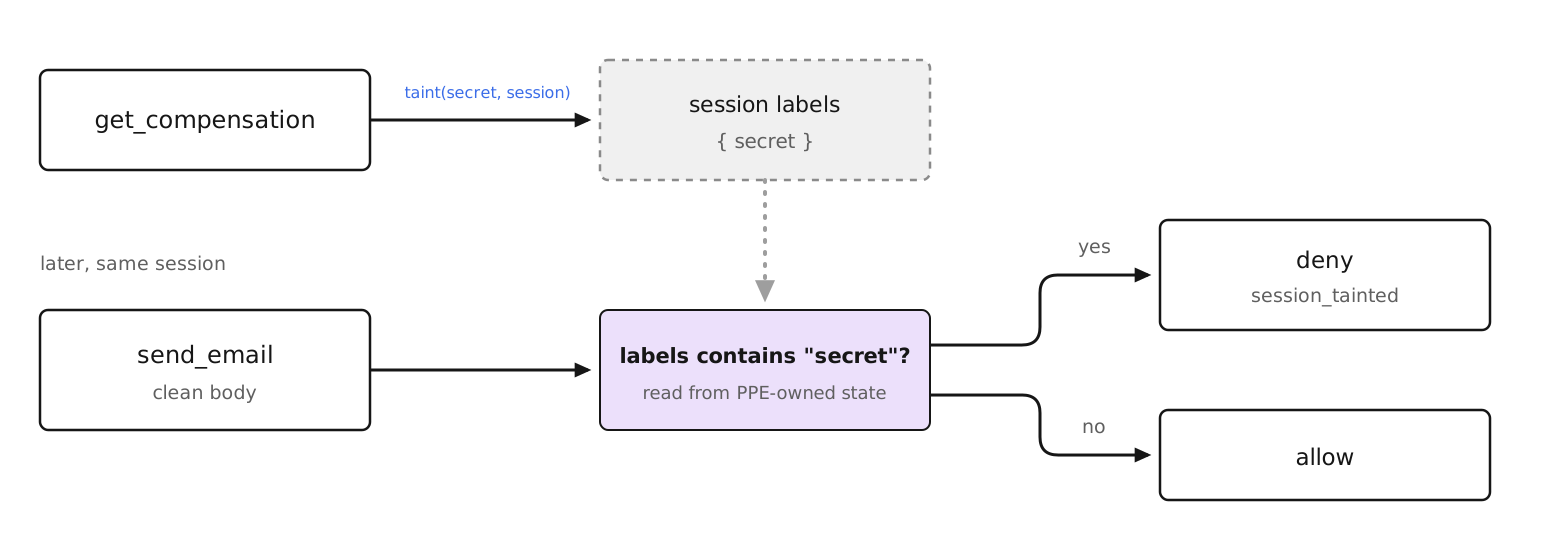
The email is denied because the session is tainted, not because of anything in its body. The decision is made from PPE-owned state, so the model cannot route around it by rewording the email.
Persistence and isolation
Session Taint labels live in a session store. The default is in-process memory;
the bundled valkey store persists them across processes and restarts:
global:
  session_store:
    kind: valkey
    endpoint: localhost:6379
Labels are scoped per subject. Two callers sharing a session identifier do not share taint: a label set while acting as one subject does not leak into another subject’s decisions. With the Valkey store, labels survive a gateway restart, so a long-running session’s information-flow history is not lost.
Pipeline integration
taint is an effect; reading labels is an attribute check (security.labels contains ...) like any other predicate. The session store is a registered
capability the runtime writes to after a tainting effect and reads from when
building the attribute bag. Both operations happen inside PPE, so the untrusted
model cannot forge the Session Taint history used for write-down enforcement.
Next
- Backend Restriction: apply Session Taint labels to backend selection.
- Configuration: configure the session store and other runtime components.