Identity and Token Exchange / Delegation
On this page
PPE resolves the inbound caller and mints the outbound credential on every request. Select the recipe matching the required principal, copy its plugin and route configuration, then check the support matrix for tested IdPs.
The same config runs wherever you place it: in front of the tools, inside the tool server, or agent-side (see Where to place PPE). Throughout this page “the enforcement point” means “wherever this PPE instance runs.”
For the conceptual model first, read Use Cases and Deployment; for the full config schema, see Configuration.
The model in one picture
Every request crosses two identity boundaries:
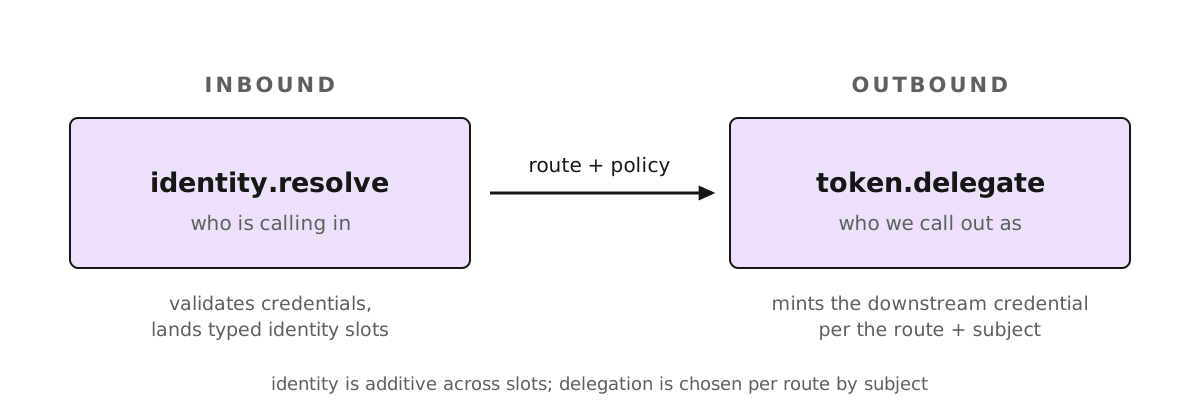
- Inbound.
identity.resolveplugins each read one credential (from a header) and land a typed identity in a slot. They are additive: one request can carry a user token and a workload SVID, both validated. - Outbound. A
delegate(...)step in the route runs atoken.delegateplugin that mints the credential attached to the upstream call. The step’ssubject:chooses what the minted token speaks for.
Building blocks
Identity slots (inbound)
| Slot | Who it is | Typical header | Resolver |
|---|---|---|---|
subject | the human on whose behalf the call is made | X-User-Token | identity/jwt (role: user) |
client | the OAuth app / agent as a registered client | Authorization | identity/jwt (role: client) |
caller_workload | the calling workload’s own identity (e.g. a SPIFFE SVID) | X-Workload-Token | identity/jwt (role: caller_workload) |
Delegation subjects (outbound)
The subject: on a delegate(...) step decides the OAuth mechanism the
delegator uses:
subject: | Minted token speaks for | Mechanism |
|---|---|---|
user (default) | the human, on-behalf-of | RFC 8693 token exchange (subject_token = the user’s token) |
caller_workload | the calling agent, as itself | RFC 7523 client assertion (the SVID) → then scope down |
this_workload | the PPE instance’s own identity, as itself, no inbound credential | RFC 6749 §4.4 client_credentials |
this_workloadnames this PPE instance acting as its own identity, whatever you’ve deployed it as. It does not claim PPE is a gateway. (gatewayis accepted as a deprecated alias.)
“I want to…” → mechanism
| I want to… | Use | Spec |
|---|---|---|
| act as a service with no user | subject: this_workload → client_credentials | RFC 6749 §4.4 |
| act on behalf of a signed-in user | subject: user → token exchange | RFC 8693 |
| let a workload authenticate as itself by its SVID | subject: caller_workload → client assertion | RFC 7523 + draft-ietf-oauth-spiffe-client-auth |
| record both the user and the calling agent in the token | subject: user, actor: caller_workload | RFC 8693 actor_token |
| forward a token the caller already obtained | no delegate, pass the header through | — |
| authenticate a caller holding an opaque API key | identity/api-key → directory lookup | — |
Scoping: how broadly to apply it
PPE resolves the pipeline for each request across one broad → narrow stack, and both identity and policy (including delegation) ride it. Narrower layers add to (or override) broader ones. Pick the broadest layer that’s still correct.
A group is a named, reusable bundle of policy (authentication steps + authorization steps + plugins) that routes opt into. The layers, broad to narrow:
| Layer | Applies to | Identity uses… | Policy / delegation uses… |
|---|---|---|---|
| Global | every request | global.authentication | always-on global policy |
| Default (per entity type) | every tool / prompt / resource | — | global.defaults.<tool|prompt|resource> |
| Group | routes that join <name> (via groups: or a matching tag) | groups.<name>.authentication | groups.<name>.authorization / plugins |
| Route (entity) | one route (a tool: "*" route is the catch-all) | route authentication: | route authorization: steps / plugins: |
delegate(...) is not route-only. Place it (or a
token.delegate plugin) at the matching layer:
- every tool → a
delegate()in atool: "*"route, or the delegator plugin indefaults.tool, - a class of tools → a group,
- one tool → a specific route (which overrides the
*default; more specific wins).
The stack in one config
plugins:
  - name: jwt-user
    kind: identity/jwt
    hooks: [identity.resolve]
  - name: jwt-manager
    kind: identity/jwt
    hooks: [identity.resolve]
  - name: workday-oauth
    kind: delegator/oauth
    hooks: [token.delegate]

global:
  authentication: [jwt-user]            # every request gets user identity

groups:
  hr-tools:
    authentication: [jwt-manager]       # + manager identity for this group
    authorization:
      pre_invocation:
        - "require(role.hr)"            # + policy for this group

routes:
  - tool: get_compensation
    groups: hr-tools                    # join the group: jwt-user + jwt-manager, require(role.hr)
    authorization:
      pre_invocation:
        - "delegate(workday-oauth, target: workday-api, audience: workday-api, permissions: [read_compensation])"
groups: hr-tools is the first-class way to join a group, and it is sugar
over tags: meta: { tags: [hr-tools] } is exactly equivalent, and
host-injected runtime tags join groups the same way.
The override. A route that must stand alone drops the inherited layers:
plugins:
  - name: jwt-workload
    kind: identity/jwt
    hooks: [identity.resolve]

routes:
  - tool: get_directory
    authentication:
      replace_inherited: true           # ignore global + group layers
      steps: [jwt-workload]             # authenticate by the SVID alone
That is what Recipe 2 uses. (Full group / defaults syntax: Configuration.)
Rule of thumb
| You want… | Put it at |
|---|---|
| the same identity everywhere | global authentication |
| a recurring identity/plugin set across many tools | a group |
| one route handled differently, standalone | a route (authentication: replace_inherited for identity) |
| one delegation for most tools, exceptions for a few | a default (tool: "*" route or defaults.tool) + specific overrides |
Recipes
Each recipe is a drop-in: the plugins it needs, the route layout, and where it’s been tested. All config is unified-config YAML.
One spelling. These recipes write policy under
authorization:, withpre_invocation:andpost_invocation:inside it. That is now the only spelling. Theapl:wrapper is gone at every scope, and a phase list written flat on a route is a load error. Both were accepted once; see Upgrading APL for the rewrite.
Recipe 1: User acting through an agent (on-behalf-of)
When: a human is signed in; the agent calls a downstream API as that user. PPE exchanges the user’s IdP token for a downstream-audience token.
plugins:
  - name: jwt-user
    kind: identity/jwt
    hooks: [identity.resolve]
    config:
      role: user
      header: X-User-Token
      trusted_issuers:
        - issuer: "https://idp.example.com/realms/corp"
          audiences: ["ppe"]        # the audience the user token is minted for
          algorithms: ["RS256"]
          decoding_key: { kind: jwks_url, url: "https://idp.example.com/realms/corp/protocol/openid-connect/certs" }

  - name: workday-oauth
    kind: delegator/oauth
    hooks: [token.delegate]
    capabilities: [read_inbound_credentials, write_delegated_tokens]
    config:
      token_endpoint: "https://idp.example.com/realms/corp/protocol/openid-connect/token"
      client_id: "ppe"              # this PPE instance's own OAuth client
      client_secret_source: { kind: env_var, name: IDP_CLIENT_SECRET }

global:
  authentication: [jwt-user]

routes:
  - tool: get_compensation
    authorization:
      pre_invocation:
        - "require(role.hr)"
        - "delegate(workday-oauth, target: workday-api, audience: workday-api, permissions: [read_compensation])"
The minted workday-api token is attached to the upstream call. Tested:
Keycloak 26.x (Standard Token Exchange v2).
Recipe 2: Agent acting as itself, by its SPIFFE SVID
When: the agent is the principal (no human), and you don’t trust the agent to hold downstream authority. The agent presents its SVID; PPE brokers a scoped downstream token. The agent holds no standing entitlement to the target.
The SVID is a JWT, but not an IdP token. A JWT-SVID is an
ES256JWT signed by SPIRE (validated against SPIRE’s JWKS, not your IdP’s): a SPIFFE identity credential, not an OAuth access token. It can’t be forwarded to the downstream or used as a bearer/subject token as-is; PPE must turn it into an IdP-issued token first (leg 1 below). Contrast Recipe 5, whose input is a token already minted from an SVID.
Add a workload resolver, scoped to the route so only it runs there:
plugins:
  - name: jwt-workload
    kind: identity/jwt
    hooks: [identity.resolve]
    on_error: fail
    config:
      role: caller_workload
      header: X-Workload-Token
      trusted_issuers:
        - issuer: "https://spire-oidc.internal:8443"   # SPIRE OIDC discovery
          audiences: ["https://idp.example.com/realms/corp"]   # SVID aud = the IdP
          algorithms: ["ES256"]                                # SVIDs are EC-signed
          decoding_key: { kind: jwks_url, url: "https://spire-oidc.internal:8443/keys" }

routes:
  - tool: get_directory
    # Authenticate this route by the SVID alone: drop the global user/client
    # resolvers. `jwt-workload` is NOT in global.authentication.
    authentication:
      replace_inherited: true
      steps: [jwt-workload]
    authorization:
      pre_invocation:
        - "delegate(workday-oauth, target: workday-api,
                    audience: workday-api,
                    permissions: [read_compensation],
                    subject: caller_workload)"
        - "!delegation.granted: deny"
For subject: caller_workload, the OAuth delegator runs two legs: leg 1
presents the SVID as an RFC 7523 client_assertion (type …:jwt-spiffe) to
authenticate the agent as its IdP client; leg 2 exchanges that for the scoped
downstream token. The IdP side needs a SPIFFE identity provider (validates the
SVID against SPIRE’s trust bundle) and a client bound to that SVID via
SPIFFE/federated client authentication; consult your IdP’s SPIFFE client-auth
docs. Tested: Keycloak 26.6 (feature spiffe:v1).
Why route-scope it: keeping the workload authority off the agent’s own identity, and requiring the enforcement point’s credential for the scope-up, is what makes PPE the trust boundary. A compromised agent can prove who it is but cannot mint the downstream token itself.
Recipe 3: A service acting as itself
When: PPE calls a downstream as itself, with no inbound credential to exchange (e.g. a scheduled job, or PPE’s own housekeeping).
routes:
  - tool: sync_directory
    authorization:
      pre_invocation:
        - "delegate(svc-oauth, target: workday-api, audience: workday-api, subject: this_workload)"
subject: this_workload switches the delegator to client_credentials: no
subject_token, PPE’s own client_id/secret is the identity. Tested:
Keycloak (client_credentials).
Recipe 4: Forward a token the caller already has (passthrough)
When: the agent authenticated to the IdP itself and hands PPE a ready token.
PPE validates it inbound and lets the route forward it, with no delegate step.
This is the “agent-brokered” case; it needs no delegation code, only that the
inbound resolver validates the token and the route allows the call.
Recipe 5: Scope a token the agent already holds (1-leg)
When: the agent authenticated to the IdP itself with its SVID and got back a normal JWT, and you still want PPE to narrow that token per-tool (least privilege at the boundary) without ever handling the SVID.
The token is not the SVID. The agent presented its SVID as a
client_assertionupstream and received an ordinary IdP access token. That token arrives here like a user token: same header, same JWKS validation,RS256(an IdP-signed JWT), not theES256SVID. PPE never sees the SVID; it sees a normal token.
plugins:
  - name: jwt-agent
    kind: identity/jwt
    hooks: [identity.resolve]
    config:
      role: client                 # the agent as an OAuth client
      header: Authorization        # a normal bearer token, NOT X-Workload-Token
      trusted_issuers:
        - issuer: "https://idp.example.com/realms/corp"
          audiences: ["ppe"]
          algorithms: ["RS256"]    # an IdP-issued JWT, not the ES256 SVID
          decoding_key: { kind: jwks_url, url: "https://idp.example.com/realms/corp/protocol/openid-connect/certs" }
routes:
  - tool: get_directory
    authorization:
      pre_invocation:
        - "delegate(workday-oauth, target: workday-api,
                    audience: workday-api,
                    permissions: [read_compensation],
                    subject: client)"
This is a plain RFC 8693 exchange, the same engine as Recipe 1, scoping the agent’s token instead of a user’s. One leg (the scope): the agent did the authenticate leg upstream, so PPE doesn’t.
Don’t confuse this with Recipe 2. The trigger is what the agent presents: an SVID, or a token minted from one:
| Agent presents | Slot → subject | PPE does | Legs |
|---|---|---|---|
its SVID (ES256, SPIRE JWKS) | caller_workload → subject: caller_workload | authenticate + scope | 2 (Recipe 2) |
a token minted from its SVID (RS256, IdP JWKS) | client → subject: client | scope only | 1 (this recipe) |
| a token already right for the tool | — | forward as-is | 0 (Recipe 4) |
Using subject: caller_workload on an already-minted token misroutes it down
the two-leg client_assertion path.
Recipe 6: User acting through an agent, with the agent named (dual-principal)
When: a human is signed in and you want the record to name the agent that
carried out the call. The minted token speaks for the user (sub), and PPE
additionally names the calling agent as the RFC 8693 acting party (act), so a
token service that honors delegation records both who authorized the action and
who performed it.
It composes two inbound resolvers: jwt-user (Recipe
1) for the human on
X-User-Token, and jwt-workload (Recipe
2) for the agent’s SVID on
X-Workload-Token. Both must resolve; both credentials arrive on every call.
plugins:
  - name: jwt-user            # Recipe 1
    kind: identity/jwt
    hooks: [identity.resolve]
  - name: jwt-workload        # Recipe 2
    kind: identity/jwt
    hooks: [identity.resolve]
  - name: workday-oauth
    kind: delegator/oauth
    hooks: [token.delegate]

global:
  authentication: [jwt-user, jwt-workload]   # run both

routes:
  - tool: get_compensation
    authorization:
      pre_invocation:
        - "require(role.hr)"
        - "delegate(workday-oauth, target: workday-api, audience: workday-api,
                    permissions: [read_compensation],
                    subject: user, actor: caller_workload)"
subject: user makes the user’s token the RFC 8693 subject_token (exactly as
Recipe 1); actor: caller_workload additionally attaches the agent’s SVID as the actor_token,
requesting that the minted token carry act alongside sub. This is one
exchange call with two principals in the request, not a second leg. actor
accepts only inbound credentials (user, client, caller_workload): the
acting party is by definition one that presented itself to PPE.
Subject vs. actor. The subject is who the token speaks for (whose authority); the actor is who is doing it (attribution). Least-privilege scoping still follows the subject. The
actclaim records the agent, it doesn’t grant it anything.
Which actor, client or caller_workload? Match it to how the agent
authenticated. An agent that presented a SPIFFE SVID is a caller_workload
(above); one that authenticated as a registered OAuth client (an Authorization
bearer token, resolved with role: client) is actor: client:
- "delegate(workday-oauth, target: workday-api, audience: workday-api,
            permissions: [read_compensation], subject: user, actor: client)"
Valid combinations.
actor:pairs withsubject: userorsubject: client, the on-behalf-of shape. It is not supported withsubject: caller_workload(the workload is already the subject) orsubject: this_workload(aclient_credentialsgrant carries noactor_token); PPE rejects those at config time rather than silently dropping the actor.
PPE side: implemented and e2e-tested against a mock IdP. The delegator puts the
actor on the wire exactly as RFC 8693 delegation prescribes (actor_token +
actor_token_type), and omits it when no actor is configured.
Interop:
actis the token service’s job (impersonation vs. delegation). RFC 8693 (§1.1) exchanges come in two flavors. Impersonation returns a token that speaks purely for the subject, indistinguishable from one the subject fetched directly, with noactclaim. Delegation additionally records the actor in a nestedact. Theactor_tokenparameter is what asks for delegation; only a token service that implements the delegation path emitsact. PPE always sends the delegation request, but the claim only appears if the service honors it.Keycloak does not. Keycloak’s Standard Token Exchange (v2, tested here on 26.6) implements impersonation only: it silently ignores
actor_tokenand returns a subject-only token with noact. The tell (probed 2026-07-28): passing even a raw, untrusted-issuer SVID as the exchange’sactor_tokenproduces no error. Keycloak never parses the parameter, so no mapper or config can surface it. To seeactend-to-end you need a delegation-capable token service; against Keycloak, capture the acting agent at the PPE boundary (audit / downstream header) instead. PPE resolves both principals either way.
Recipe 7: An opaque API key, resolved against a directory
Use identity/api-key when a caller presents an opaque key. The resolver looks
up its record and maps fields into the same identity attributes as identity/jwt.
File directory:
plugins:
  - name: api-keys
    kind: identity/api-key
    hooks: [identity.resolve]
    config:
      credential:
        kind: header
        name: X-API-Key
      provider:
        kind: file
        path: /etc/ppe/keys.yaml
        refresh_secs: 30
        max_staleness_secs: 300
      record_map:
        subject:
          id: user
          roles: groups

global:
  authentication: [api-keys]
The file stores SHA-256 digests, not plaintext keys. Use high-entropy keys to resist offline guessing if the file leaks:
keys:
  - hash: "sha256:59ecf12ac9ef5ee967ddd8aa324f39c7fe13f2a54fb76e3e69bc866887cff903"
    user: alice
    groups: [reader, writer]
    tenant: acme
    expires_at: 2027-01-01T00:00:00Z
Generate a digest with printf %s "$KEY" | sha256sum and add the sha256: prefix.
HTTP directory: This example uses the RHOAI MaaS maas-api validate endpoint.
plugins:
  - name: maas-keys
    kind: identity/api-key
    hooks: [identity.resolve]
    capabilities: [perform_http]
    config:
      credential:
        kind: header
        name: Authorization
      prefix: "Bearer sk-oai-"
      provider:
        kind: http
        url: "https://maas-api.example.com/internal/v1/api-keys/validate"
        timeout_secs: 5
      record_map:
        subject:
          id: username
          roles: groups
      claims:
        exclude: [userId, keyId, keyName]
      cache:
        ttl_secs: 60
        negative_ttl_secs: 10

global:
  authentication: [maas-keys]
maas-api sets both userId and keyId to the key’s database row ID. Map
username to subject.id instead. A captured response uses a Kubernetes
service account name (system:serviceaccount:example-tenant:example-consumer)
and Kubernetes groups. These are subject values; caller_workload requires a
SPIFFE ID.
Group names containing : cannot be used in attribute paths such as
role.system:authenticated. Use the canonical set:
require(subject.roles contains "system:authenticated")
An invalid key returns HTTP 200 with valid: false; a failed directory request
denies as auth.directory_unavailable. In prefix: "Bearer sk-oai-", the
Bearer scheme is matched without case and removed. The sk-oai- prefix stays
in the key sent to the directory. To accept several key populations on one
route, configure a resolver for each prefix; nonmatching resolvers skip their
directory lookup.
The presented key is not stored in raw_credentials for downstream forwarding.
Use secret.<name> on an assertion to authenticate to an upstream.
Denial codes
| Code | Means |
|---|---|
auth.missing_credential | nothing at the configured location |
auth.empty_credential | the location held an empty value |
auth.key_unknown | the directory answered, and no record matched |
auth.key_expired | a record matched and has expired |
auth.directory_unavailable | the directory could not answer |
auth.mapping_failed | a record resolved and the map could not project it |
The revocation window
A revoked key may still authenticate until the file’s next successful reload
(refresh_secs) or the HTTP cache entry expires (cache.ttl_secs). If a file
reload fails, old records remain in use until max_staleness_secs; after that,
lookups deny as auth.directory_unavailable. A cache cannot be configured over
a file directory.
The MaaS mapping was checked against a captured valid response on 2026-09-24.
HTTP error handling follows the maas-api source; error responses were not
captured from the deployment.
Reading claims the way your IdP writes them
The JWT identity plugin infers a subject from a token’s claims. Which claims, and where they sit, differs by IdP, so the mapping is configuration rather than something to patch a crate for.
Name one of the five shipped presets:
claim_mapper: keycloak # standard | keycloak | auth0 | cognito | ibmverify
Or write the map inline, with candidate paths tried in order:
claim_map:
  subject:
    roles:
      paths:
        - realm_access.roles
        - resource_access.my-api.roles
      merge: union             # first_match (default) | union
    permissions:
      paths:
        - { path: permissions, array_only: true }
        - scope
      split: whitespace        # break a delimited string into elements
      on_missing: deny         # ignore (default) | deny
. separates path segments and \ escapes one; every other
character, : and / included, is a literal. cognito:groups is
one segment written plainly, and escaping the colon is rejected rather
than quietly accepted. A field whose candidates all miss is left empty
and logged, naming every path tried; on_missing: deny makes that a
refusal instead.
Each preset records what it omits. The Keycloak preset maps
realm_access.roles; roles under resource_access.<client-id>.roles require a
custom map because the client ID varies by deployment. Auth0 roles also require
a custom map because their namespace is deployment-specific. Presets leave
fields empty rather than assign the wrong concept: Keycloak’s groups can
contain realm roles, and Cognito’s cognito:roles contains IAM role ARNs.
The ibmverify preset accepts scalar or array values for tenant-provisioned
roles, teams, permissions, client roles, and authorized scopes. Verify can emit
a scalar when one value is present; the standard preset reads these collections
as arrays and would leave a scalar value empty.
Naming no mapper resolves to standard, so an existing configuration
is unaffected.
Gating on which IdP minted a token
Registered claims are dropped from the policy-visible bag by default.
That left a deployment trusting several issuers unable to gate on
which one signed. claims: overrides that, and is a sibling of both
the preset and the inline map:
claim_mapper: keycloak
claims:
  include: [iss]               # keep one the inference drops
  exclude: [internal_debug]    # drop an otherwise-visible claim
claim.iss is then readable from policy. Both lists take top-level
claim names, since the bag is keyed by name: a dotted entry is refused
at load rather than matching nothing, and a claim whose own name holds
a dot is written with \.. A role: caller_workload resolver carries
no claims bag and says so at load rather than ignoring the setting.
Caching a delegated token
A token exchange is a network call on the request path. The optional
cache: block holds a minted token until it expires:
cache:
  enabled: true
  subjects: [this_workload, client]
  max_entries: 10000
  ttl_ceiling_seconds: 300
The default subjects are this_workload and client, which have
bounded cardinality. user and caller_workload are opt-in through
cache.subjects for exactly that reason: one entry per user is not a
cache, it is a leak with an eviction policy.
Concurrent misses for one key share a single exchange rather than
stampeding the IdP, and a failure is never cached.
ttl_ceiling_seconds bounds how long a cached token can outlive a
revocation at the IdP, which is the real cost of caching here: the IdP
can revoke, and a cached token does not hear about it until the ceiling
expires.
A route that delegates an unvalidated credential
A delegate step whose subject exchanges the caller’s own token
relies on identity resolution having checked that token. But
authentication: is per-route and optional, so a route can reach the
delegator with a credential this process never validated.
Loading reports it, under alarm = "delegation_without_identity_resolution",
naming the route and the delegate plugins on it. subject: this_workload
is excluded, since it carries no inbound credential.
Where to place PPE
See Deployment → Placement guidance. The identity-specific read:
| Placement | Use it when | Because |
|---|---|---|
| In front of the tools (proxy / gateway) | agents are untrusted; you want one chokepoint | PPE becomes the trust boundary that holds downstream authority; agents can’t bypass it |
| In the MCP / tool server | defense in depth, or no proxy in the path | the resource enforces even if a front door is skipped; validates the caller right at the data |
| Agent-side | the agent is trusted and you want it to self-limit | least-privilege hygiene at the source, not a control against a compromised agent |
Run PPE at multiple points to combine agent-side restriction, a gateway chokepoint, and resource defense in depth. Each placement uses the same APL policy at a different boundary.
IdP support matrix
PPE’s identity/delegation plugins are configured against OAuth/OIDC standards, not any one vendor. Per layer:
| Capability | Standard | Tested | Should work (untested) |
|---|---|---|---|
| JWT validation (any inbound token) | JWT + JWKS (RFC 7519/7517) | Keycloak | Okta, IBM Verify, Auth0, any OIDC IdP; point at its JWKS + issuer |
Service token (client_credentials) | RFC 6749 §4.4 | Keycloak | broadly supported |
| On-behalf-of exchange | RFC 8693 | Keycloak (STE v2) | IdPs vary in RFC 8693 support; verify per target |
| SVID as client credential | RFC 7523 + draft-ietf-oauth-spiffe-client-auth | Keycloak 26.6 (spiffe:v1) | emerging; an IETF OAuth WG draft, other IdPs not yet confirmed |
If the IdP does not support SPIFFE, PPE can still validate
the SVID itself (it already fetches SPIRE’s JWKS in identity.resolve),
establish caller_workload, and then mint the downstream token using its own
credentials (subject: this_workload). This changes attribution: a
client_credentials grant carries no caller identity, so the minted token
speaks for PPE, not the agent. Capture the caller at the PPE boundary (audit) if
the backend needs it. That “PPE-validates, PPE-mints-as-itself” mode works with
any OIDC IdP today; only the recipe-2 native flow needs the IdP to understand
SVIDs.
“Tested” means the flow passed an end-to-end test against that IdP. “Should work” means the IdP documents support for the required standards, but the flow has no end-to-end result.
Next
- Header Assertions: project resolved identity onto upstream requests.
- Deployment: place identity and delegation controls at the required boundary.