A Reference Monitor for Agents
On this page
An agent backed by an LLM acts across trust domains. It calls tools, invokes other agents, runs inference, and fetches prompts and resources. The model deciding which operation to run is untrusted: it can be steered by injected content, confused by tool output, or simply wrong. Authorization, delegation, and information-flow control cannot live inside that model.
PPE puts them at the boundary. It is a deterministic Reference Monitor between the untrusted LLM and the capabilities it invokes. Every operation passes through PPE, which decides what happens using state the model cannot see or forge.
The state the model cannot forge
A policy decision is only as trustworthy as the state it reads. PPE evaluates each operation against state it owns, not state the LLM supplies:
- Identity: who the caller is, resolved from verified tokens (subject, roles, permissions, claims, workload identity).
- Delegation chains: which credentials were minted on whose behalf, and with what scope.
- Session Taint: labels recording the sensitive data this session has touched.
- Audit log: an append-only record of every decision.
The LLM never sees these and cannot rewrite them. That is what makes PPE a Reference Monitor rather than an advisory control.
Policy is configuration
Write enforcement logic in APL (Authorization Policy Layer), not application code. APL configuration defines each operation’s pipeline and binds predicates and effects to the operation they govern.
routes:
  - tool: get_compensation
    authorization:
      pre_invocation:
        - "require(role.hr)"
        - "delegate(workday-oauth, target: workday-api, permissions: [read_compensation])"
        - "taint(secret, session)"
    result:
      ssn: "str | redact(!perm.view_ssn)"
This route requires the caller to be in the HR role, mints a scoped downstream
token for the backend, marks the session as having touched secret data, and
redacts the SSN on the wire unless the caller holds the view_ssn permission.
The decision is the same for every caller; the outcome differs by identity.
Three layers
Enforcement is three concerns, separated cleanly:
| Layer | Role |
|---|---|
| APL | How you define policy: declarative configuration that sequences the controls in an operation’s enforcement pipeline. |
| Common Message Format (CMF) | What APL evaluates: a protocol-agnostic envelope carrying identity, labels, delegation, and content. |
| Pipeline (hooks, plugins, execution) | How effects run. The mechanism that executes a policy’s effects at the boundary. |
APL leads. CMF gives policy a uniform thing to evaluate across tools, A2A methods, inference, prompts, and resources. The pipeline is the supporting execution layer: it is what lets a policy effect call a PDP, mint a token, scan for PII, or write an audit record. You reach for it when you extend the set of effects available to policy, not when you write policy.
The policy spectrum
Different controls belong at different points. PPE runs the same way at each of them, so you place a policy where its enforcement point is, not where the framework forces it.
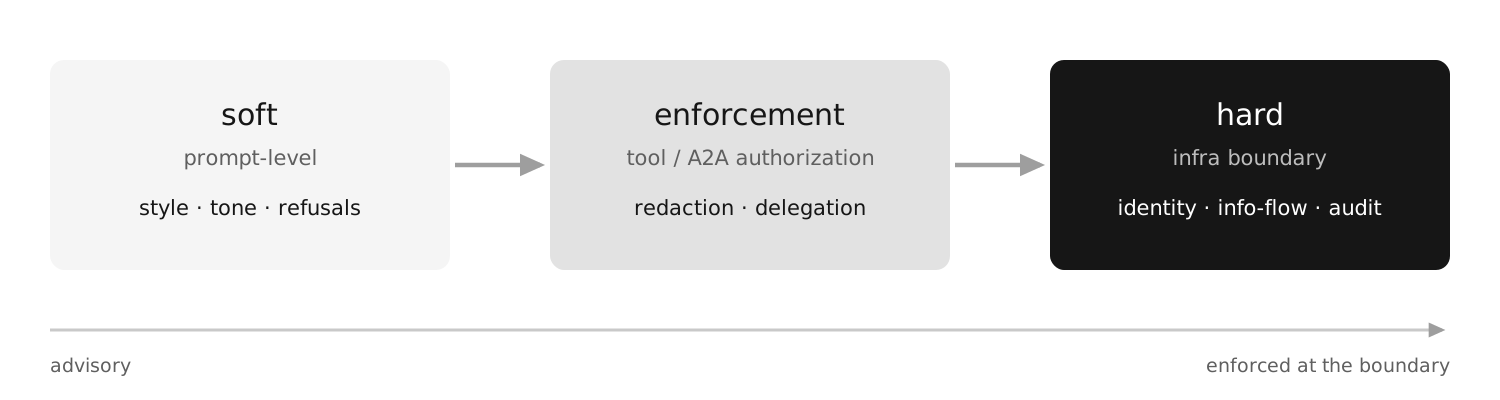
A style guardrail at the prompt level and a hard information-flow control at an infrastructure boundary are the same kind of object: an APL policy evaluated by a PPE Reference Monitor. Only the placement changes.
Where PPE runs
PPE is direction-agnostic. It enforces the same policy whether it sits in front of a tool server as a gateway, beside an agent as an egress sidecar, or inside an agent framework. Deployment describes each placement.
Related documentation
- Threat Model: the adversary, trust boundary, and coverage of each placement.
- Overview: the Reference Monitor applied to one scenario.